
Ants in the kitchen are one of the most common pest issues homeowners deal with, especially in spring and summer. They often seem to appear overnight, forming trails along countertops, floors, and cupboards in search of food. What starts as a small nuisance can quickly turn into a persistent problem if not handled properly.
Getting rid of ants in your kitchen requires more than wiping them away or spraying the ones you see. To solve the issue effectively, you need to understand why they are there, where they are coming from, and how to eliminate the source of the infestation.
Kitchens provide everything ants need to survive. Even the smallest crumbs, spills, or food residues can attract them. Sugary substances, grease, and protein sources are all highly appealing.
Ants operate as part of a colony. When one ant finds food, it leaves behind a scent trail that guides others to the same location. That’s why you often see long lines of ants moving back and forth. What you are seeing is only a fraction of the colony, with many more hidden behind walls, under floors, or outside near your home. Moisture also plays a role. Areas around sinks, dishwashers, and leaky pipes create ideal conditions for ants to gather and thrive.
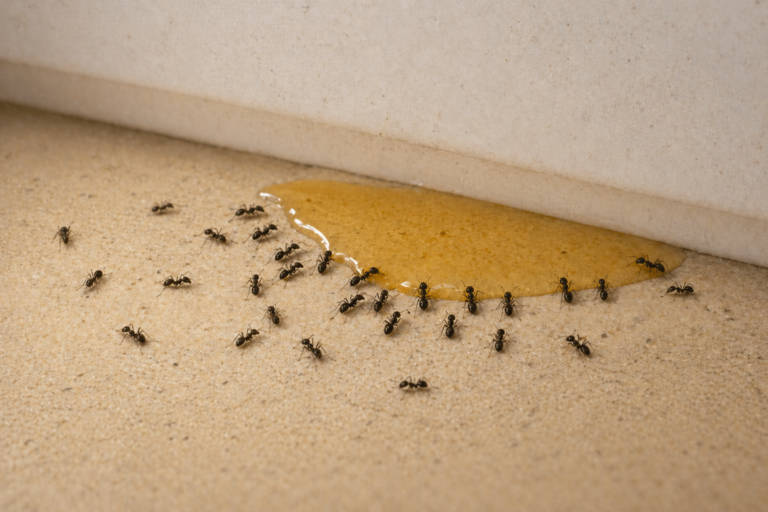
One of the biggest frustrations homeowners face is that ants seem to return no matter how many times they are cleaned up or sprayed. This happens because most DIY solutions only deal with the surface activity. Killing visible ants does not eliminate the colony. As long as the nest remains intact, new ants will continue to enter your kitchen.
In many cases, the colony is located outside the home, with ants entering through small cracks in the foundation, gaps around windows, or openings near doors. In other situations, especially with carpenter ants, nests may be inside walls or structural areas. Without targeting the source, the problem often repeats itself.
Before you can get rid of ants effectively, it helps to understand their entry points and travel paths. Ants typically follow edges and corners. You may notice them moving along baseboards, across countertops, or behind appliances. Following their trail can sometimes lead you to where they are entering.
Common entry points include small cracks in walls, gaps around window frames, openings near plumbing, and spaces under doors. Even the tiniest opening can be enough for ants to get inside. Outdoors, nests are often found in soil, under stones, along foundations, or in landscaping areas close to the home.
Eliminating ants requires a combination of immediate action and long-term prevention. Start by cleaning thoroughly. Wipe down countertops, sweep floors, and remove any accessible food sources. Pay close attention to areas that are often overlooked, such as under appliances and inside cabinets. Next, disrupt the scent trails. Ants rely heavily on these trails to navigate. Cleaning with a mild household cleaner or vinegar solution can help break these pathways and reduce activity.
While sprays can kill ants on contact, they are not always the best long-term solution. In many cases, sprays can cause ants to scatter and create multiple new trails, making the problem harder to control. Depending on the species of ants, baiting is often more effective. Ant baits work by attracting ants, which then carry the product back to the colony. This allows the treatment to reach the source rather than just the ants you see. However, proper placement is key. Baits need to be placed along active trails and in areas where ants are travelling, not randomly around the kitchen.
Even after reducing ant activity, preventing them from coming back is just as important. Sealing entry points helps limit access to your home. This includes caulking small cracks, repairing gaps around windows and doors, and addressing openings where pipes or cables enter.
Keeping vegetation trimmed away from the home can also reduce the likelihood of ants finding easy access points. Inside, storing food in sealed containers and maintaining consistent cleaning habits will make your kitchen less attractive to ants.
Not all ants are the same, and identifying the type can affect how the problem is treated.
Small black ants and pavement ants are commonly found in kitchens and are usually searching for food. These are often easier to control with proper baiting and sanitation.
Carpenter ants are larger and more concerning. They can nest inside wood structures and may indicate moisture issues or structural vulnerabilities. If carpenter ants are present, it is important to address the problem quickly to avoid further damage.
Pharaoh ants and other species can be more difficult to control and often require professional treatment due to their complex colony structures.

Many homeowners spend weeks or even months trying to deal with ants on their own without lasting results. The issue is rarely the ants you see. The real problem lies in the colony.
Professional ant control focuses on eliminating the source of the infestation. At AVID Pest, our approach starts with identifying the type of ants and locating where they are coming from. We use targeted treatments that are designed to reach the colony and stop the problem at its root. This may include specialized baits, exterior treatments, and strategic applications in key areas. We also provide recommendations to help prevent future infestations, ensuring that your home stays protected long after the treatment is complete.
Once ants are gone, ongoing prevention makes a big difference. Maintaining a clean kitchen is one of the most effective ways to reduce the risk. Regularly wiping surfaces, cleaning spills quickly, and avoiding leaving food out overnight all help. Checking for moisture issues, such as leaks under sinks, can also reduce conditions that attract ants. Seasonal treatments can be especially helpful, particularly in spring when ant activity begins to increase. Taking proactive steps during this time can prevent infestations before they start.
If ants have taken over your kitchen, you don’t have to deal with it on your own. Professional treatment can save you time, frustration, and repeated attempts that don’t fully solve the problem. At AVID Pest, we provide fast, effective ant control designed to eliminate infestations at the source. Whether you are dealing with a small trail of ants or a larger ongoing issue, our team is ready to help.
Contact AVID Pest today to book your service and get your kitchen back to being clean, comfortable, and ant-free.
Looking for the best pest control service in Ontario? At Avid Pest Services, our exterminators are skilled to prevent any kind of pest from your residential and commercial area in a timely and efficient manner. Call today to get a free quote.
2023 Avid Pest Services. All Rights Reserved.
