
Carpenter ants are one of the most destructive household pests homeowners can encounter. While they may not receive the same level of attention as termites, carpenter ants are capable of causing serious damage to homes over time. Because they tunnel through wood to build nests, an untreated infestation can eventually weaken structural components and lead to costly repairs.
Many homeowners first notice carpenter ants when they see a few large black ants crawling around the kitchen, bathroom, or windowsills. What they often do not realize is that visible ants are usually only a small part of the problem. Hidden behind walls, ceilings, or damp wood areas, a colony may already be well established.
Understanding how carpenter ants affect homes is important for protecting your property and catching infestations early before the damage becomes more severe.
Carpenter ants are large ants commonly found throughout many residential areas. Most are black, although some species can appear reddish or dark brown. Unlike termites, carpenter ants do not eat wood. Instead, they excavate it to create tunnels and galleries where they live and expand their colonies.
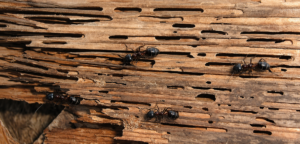
These galleries are smooth and clean inside, allowing the ants to move easily through the wood structure. Over time, continued excavation can weaken wooden materials throughout the home. Carpenter ants are especially attracted to wood that has been softened by moisture or water damage, but they are capable of expanding into dry wood as the infestation grows.
The main danger carpenter ants pose to homes is structural damage. As the colony expands, more wood is excavated to support additional ants and satellite nests. This process can affect wall studs, support beams, trim, window frames, doors, and other wooden structures.
The damage often develops slowly and remains hidden for long periods. Homeowners may not realize there is a problem until signs become more obvious or repairs are needed. While carpenter ants typically do not destroy wood as rapidly as termites, a long-term infestation can still lead to expensive structural issues if ignored.
Carpenter ants use their strong mandibles to chew through wood and create nesting galleries. They remove debris and push it out of the nest, leaving hollowed pathways behind. The ants prefer wood that is damp or already weakened because it is easier to excavate. Areas affected by leaks, poor ventilation, roof issues, or plumbing problems are especially vulnerable.
Over time, these galleries can spread through connected wooden structures. In larger infestations, carpenter ants may create multiple satellite nests throughout the home. The longer the colony remains active, the greater the amount of structural weakening that can occur.
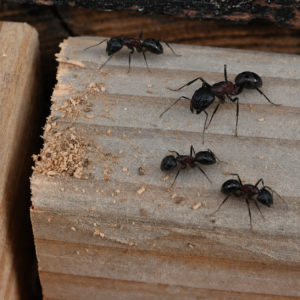
Carpenter ants are most commonly found in areas where moisture is present. Bathrooms, kitchens, basements, attics, crawlspaces, and window frames are all common nesting locations. Roof leaks and plumbing leaks often create ideal conditions for carpenter ant activity.
Exterior wooden structures can also attract carpenter ants. Decks, fences, sheds, tree stumps, and damaged siding may all serve as nesting sites. Because carpenter ants are excellent climbers, they can travel from outdoor colonies into homes using tree branches, utility lines, or siding.
One of the most common signs of carpenter ants is seeing large ants indoors, especially at night when they are most active. Homeowners may also notice small piles of wood debris called frass. This material resembles coarse sawdust and often contains pieces of insulation, insect parts, or wood fragments pushed out from the nest.
Rustling noises inside walls or ceilings can also occur when colonies become larger. Some people describe hearing faint crackling sounds during quiet nighttime hours. Winged carpenter ants inside the home are another warning sign. These reproductive ants appear when the colony matures and attempts to expand.
Any of these signs should be taken seriously because they often indicate an established infestation.
Many homeowners confuse carpenter ants with termites because both pests damage wood. However, there are important differences. Termites consume wood as food, while carpenter ants tunnel through it to create nesting space. Carpenter ant tunnels are generally smoother and cleaner inside than termite tunnels. Carpenter ants also have narrow waists, bent antennae, and larger front wings compared to termites. Although termites are usually associated with faster damage, carpenter ants can still create major problems if left untreated over several years.
Store-bought ant sprays and bait products may temporarily reduce visible activity, but they rarely eliminate carpenter ant infestations completely. One reason is that the main nest often remains hidden deep inside walls or structural voids. Killing foraging ants does not necessarily affect the rest of the colony.
Carpenter ants can also establish multiple satellite nests throughout the property, making treatment more complex than many homeowners realize. Without identifying the source of the infestation and treating it properly, carpenter ants usually continue damaging the home behind the scenes.
Moisture is one of the biggest factors contributing to carpenter ant infestations. Leaks, condensation, poor drainage, and humidity create ideal conditions for softened wood. Once carpenter ants locate these vulnerable areas, they often begin nesting and expanding throughout connected structures.
Ignoring moisture problems can make infestations harder to control because the conditions attracting the ants remain in place. Addressing both the infestation and the moisture source is critical for long-term prevention.
In severe cases, carpenter ant damage can affect the integrity of structural wood. While most infestations do not immediately make homes unsafe, long-term activity can weaken important components such as support beams, floor joists, and framing materials. The risk increases when infestations go untreated for extended periods.
Repair costs can also rise significantly once damage spreads throughout hidden areas of the structure. Early intervention is always the best approach.
At AVID Pest Services, we take a comprehensive approach to carpenter ant control by treating the entire home rather than only the areas where ants are visible. Carpenter ants are known to create satellite nests throughout a structure, which means activity in one room often points to a larger infestation hidden behind walls, ceilings, or other wood structures.
Our treatment methods are designed to target carpenter ant activity throughout the property to help eliminate both the main colony and any secondary nesting areas. We also provide recommendations to help address moisture problems, damaged wood, and other conditions that may attract carpenter ants and contribute to recurring infestations. By focusing on complete home treatment and long-term prevention, we help protect homes from ongoing carpenter ant activity and potential structural damage.
Prevention starts with reducing moisture around the home. Fixing leaks, improving ventilation, repairing damaged wood, and maintaining proper drainage can make your property less attractive to carpenter ants. Keeping firewood away from the home and trimming tree branches away from the roofline can also help reduce access.
Routine inspections are especially important for homes with previous water damage or ongoing moisture concerns. Catching carpenter ants early can prevent much larger repair costs later on.
If you have seen large black ants indoors, noticed wood shavings near walls or windows, or suspect carpenter ant activity in your home, it’s important to act quickly. Carpenter ants can cause significant structural damage over time, especially when infestations are left untreated. Professional inspection and treatment can help identify the problem early and prevent further damage.
AVID Pest Services provides professional carpenter ant control designed to locate the source of the infestation, eliminate active colonies, and help protect your home moving forward. Contact AVID Pest Services today to book your carpenter ant inspection and keep your home safe from hidden structural damage.
Looking for the best pest control service in Ontario? At Avid Pest Services, our exterminators are skilled to prevent any kind of pest from your residential and commercial area in a timely and efficient manner. Call today to get a free quote.
2023 Avid Pest Services. All Rights Reserved.
