
Ant infestations often seem simple at first. A few ants appear in the kitchen, along a windowsill, or near a doorway, and many homeowners reach for a can of ant spray. The visible ants disappear, and it feels like the problem has been solved. Unfortunately, ant infestations are rarely that simple.
What most people don’t realize is that the ants they see are only a small fraction of a much larger colony. While sprays may kill the workers that are visible, thousands more ants can remain hidden inside walls, beneath foundations, or outdoors near the home. As long as the colony survives, the infestation can continue.
Understanding how ant colonies grow helps explain why professional ant control focuses on eliminating the source of the problem rather than simply treating the ants that happen to be visible.
Every ant colony operates as a highly organized community. While different species have unique characteristics, most colonies share a similar structure. At the center of the colony is the queen. Her primary role is reproduction. Depending on the species, a queen can live for years and produce thousands of offspring during her lifetime.
Worker ants make up the majority of the colony. These are the ants homeowners usually encounter indoors. Workers gather food, care for developing larvae, maintain the nest, and defend the colony.
Some species also produce winged reproductive ants, commonly called swarmers. Their purpose is to establish new colonies and expand the population. Because the queen remains protected deep inside the nest, eliminating a few worker ants rarely affects the long-term survival of the colony.
Most ant infestations begin with a single queen. After mating, the queen searches for a suitable nesting location. Depending on the species, this could be underground, beneath concrete, inside decaying wood, under landscaping materials, or even within the walls of a home. Once settled, she begins laying eggs. The first generation of workers emerges and immediately starts gathering food and expanding the nest.
As the colony matures, growth accelerates rapidly. What started as a single queen and a handful of workers can eventually become a colony containing thousands of ants. Many homeowners only become aware of the infestation once worker ants begin foraging inside the home.
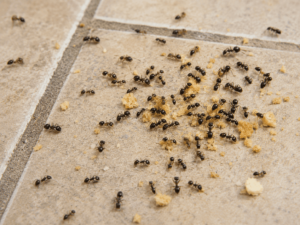
The ants visible inside your home are usually foragers. Their job is to search for food and water sources. Once a worker discovers a suitable resource, it leaves behind a chemical trail called a pheromone trail. Other workers follow this trail, creating the ant lines commonly seen along countertops, floors, and walls.
This is why a few ants can quickly become dozens or even hundreds. The workers entering your home are often travelling back and forth between the food source and the hidden colony. Killing the visible ants may temporarily reduce activity, but it does not eliminate the nest that continues producing new workers.
Certain ant species make infestations even more challenging because they develop satellite colonies. Carpenter ants are a good example. A mature carpenter ant colony may have a primary nest and several secondary nests located throughout a structure. These satellite colonies remain connected and continue supporting the overall population. This means that even if one nesting area is treated, other portions of the colony may survive.
Some species also maintain multiple queens, making colony elimination even more difficult. As long as reproductive members remain alive, the colony can continue growing. This is one reason why professional treatment strategies focus on the entire infestation rather than a single visible area.
Store-bought ant sprays can be effective at killing individual ants on contact. The problem is that they typically affect only the ants that are directly exposed. The queen, larvae, and most workers remain hidden inside the nest where the spray cannot reach them.
In some situations, spraying can actually complicate control efforts. When worker ants encounter treated areas, they may avoid them and establish new foraging routes. Certain species can even split into multiple colonies when disturbed, causing the infestation to spread.
Homeowners often experience a cycle where ants disappear briefly after spraying, only to return days or weeks later. This happens because the colony itself remains healthy and continues producing new workers.
Successful ant control depends on eliminating the colony rather than simply reducing visible activity. Professional treatments are designed to target the entire population, including workers, larvae, and the queen.
This often involves using specialized products that workers carry back to the nest. Instead of killing ants immediately, these treatments allow the active ingredient to spread throughout the colony. As workers share food with other colony members, the treatment reaches areas that sprays cannot access. This approach addresses the source of the infestation and provides longer-lasting results.
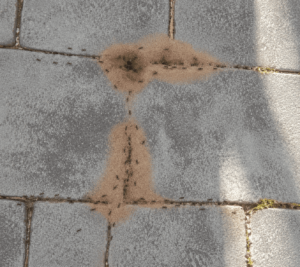
Not all ants behave the same way. Pavement ants typically nest outdoors beneath sidewalks, driveways, and foundations. Carpenter ants frequently establish nests inside wood structures and may create satellite colonies throughout a home.
Pharaoh ants can react poorly to improper treatment and may split into multiple colonies when disturbed. Because of these differences, identifying the species is a critical part of effective ant control. A treatment strategy that works well for one species may be ineffective against another.
Many homeowners become frustrated when ants return shortly after treatment. In most cases, the colony was never fully eliminated. Even if thousands of workers are removed, surviving queens continue producing new ants.
Outdoor conditions can also contribute to recurring activity. Ant colonies located near foundations, landscaping, patios, or exterior walls often continue sending workers indoors in search of food and water. Without addressing the colony itself, infestations frequently reappear. This is why professional ant control focuses on long-term management rather than quick fixes.
At AVID Pest Services, we understand that effective ant control requires more than simply spraying visible ants. Our treatments are designed to target the entire infestation, helping eliminate active colonies and reduce the likelihood of future activity. By focusing on how ants behave and how colonies function, we can provide more effective and lasting results.
Whether you’re dealing with pavement ants, carpenter ants, or other common ant species, our approach is tailored to address the source of the problem rather than just the symptoms. We also provide recommendations to help reduce conditions that attract ants, making your home less appealing to future infestations.
While professional treatment is often necessary for established infestations, prevention can help reduce the risk of future problems. Keeping food properly stored, cleaning spills quickly, reducing moisture issues, and sealing entry points can all make a home less attractive to foraging ants.
Exterior maintenance is equally important. Addressing cracks around foundations, trimming vegetation away from the home, and managing moisture near the structure can help limit ant activity. The earlier an infestation is addressed, the easier it is to control.
If you’re seeing ants inside your home, there’s a good chance the colony extends far beyond what is visible. Spraying the ants you see may provide temporary relief, but long-term control requires addressing the source of the infestation.
AVID Pest Services provides professional ant control services designed to eliminate colonies and help prevent future infestations. Our team understands how ant colonies grow and uses proven treatment methods to deliver lasting results. Contact AVID Pest Services today to schedule your ant treatment and take the first step toward a pest-free home.
Looking for the best pest control service in Ontario? At Avid Pest Services, our exterminators are skilled to prevent any kind of pest from your residential and commercial area in a timely and efficient manner. Call today to get a free quote.
2023 Avid Pest Services. All Rights Reserved.
