
Few pest problems are more frustrating than seeing ants return after you thought they were gone. Many homeowners invest time and money into ant control, only to discover new ant trails days, weeks, or even months later. Whether you used a store-bought spray, ant bait, or even professional treatment, recurring ant activity can make it feel like the infestation was never truly eliminated.
The reality is that ants are highly adaptable insects with complex colony structures. In many cases, ants that reappear after treatment are not necessarily a sign that the treatment failed. Instead, there may be underlying factors allowing new ants to continue entering the home or surviving colonies that were not completely eliminated. Understanding why ants keep coming back after treatment is the first step toward achieving long-term ant control.
One of the biggest misconceptions homeowners have is that the ants they see represent the entire infestation. The worker ants crawling across countertops, floors, and windowsills are only a small percentage of the colony. Behind the scenes, there may be thousands of additional ants hidden underground, inside walls, beneath concrete, or within nearby landscaping.
Most ant colonies are centred around one or more queens that continuously produce new workers. Even if hundreds of worker ants are eliminated, the colony can continue functioning if the queen survives. This is one reason why treatments that only kill visible ants often provide temporary relief rather than permanent control.
Many homeowners turn to aerosol sprays when ants first appear indoors. While sprays can kill ants on contact, they often fail to reach the source of the infestation. Worker ants may die immediately, but the queen and the majority of the colony remain protected elsewhere. In some situations, spraying visible ants can actually make control more difficult. Ant trails may temporarily disappear, but surviving workers often establish new routes through different parts of the home.
Homeowners frequently mistake this for a new infestation when it is actually the same colony adapting to the treatment. Unless the colony itself is eliminated, ants can continue returning long after the initial treatment.
Another reason ants return after treatment is that multiple colonies may exist on the property. Many homeowners assume they are dealing with a single nest. In reality, several separate colonies may be located around the home. Some may be nesting beneath patios, sidewalks, landscaping stones, retaining walls, or nearby trees.
Eliminating one colony does not prevent neighbouring colonies from discovering food sources and moving into the same areas. This is particularly common with pavement ants, which often establish multiple colonies throughout a property. Professional treatments often focus on reducing overall ant pressure around the home rather than targeting only one visible nesting site.
Carpenter ants present a unique challenge because they frequently establish satellite colonies. A carpenter ant infestation may include a primary colony outdoors and multiple satellite nests inside a structure. These satellite nests can be hidden within walls, attics, ceilings, window frames, and moisture-damaged wood. If only one nesting area is treated, ants from the remaining colonies may continue appearing throughout the home.
This is why AVID treats the entire home when dealing with carpenter ants. Comprehensive treatment helps address both primary and satellite colonies, reducing the likelihood of recurring activity. Without a thorough approach, carpenter ant infestations often return.
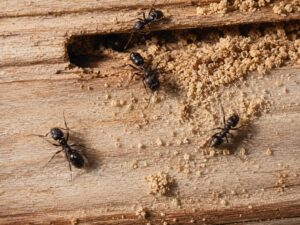
Many homeowners believe treatment has failed when they see ants months later. However, ant activity often changes throughout the year. Spring and summer are periods of increased foraging activity, causing ants to become much more visible. A colony that remained relatively inactive during cooler months may become highly active once temperatures rise.
In some cases, treatment successfully reduced one colony, but seasonal conditions allowed a different colony to begin foraging in the area later in the year. Understanding seasonal behaviour helps explain why ant sightings may increase even after a successful treatment.
Even after an infestation is eliminated, food sources can attract additional ants. Crumbs beneath appliances, sugary spills, pet food, overflowing garbage containers, and unsealed pantry items all create opportunities for foraging ants. Worker ants are constantly searching for food. Once a food source is discovered, pheromone trails help recruit additional workers. If attractive food sources remain available, new colonies may eventually find their way indoors. Good sanitation plays an important role in reducing future infestations and supporting long-term treatment success.
Food is not the only resource ants seek. Many species are strongly attracted to moisture. Leaking pipes, damp basements, condensation, clogged gutters, and poor drainage can create ideal conditions for ant activity.
Carpenter ants are especially attracted to moisture-damaged wood because it is easier for them to excavate nesting galleries. If moisture issues remain unresolved after treatment, ants may continue returning to the same areas. Addressing leaks and moisture problems is often a critical part of preventing recurring infestations.
Even effective treatments cannot stop ants from entering if access points remain available. Tiny cracks in foundations, gaps around windows and doors, utility penetrations, and openings in siding can provide easy entry for foraging ants. Many ant species require only a very small opening to gain access to a structure.
If these gaps remain unsealed, ants from nearby colonies may continue finding their way indoors despite previous treatment efforts. Exterior maintenance and exclusion work can significantly reduce future ant activity.
Ant baits can be highly effective when used correctly, but improper placement often limits their success. Many homeowners place bait stations in areas where ants are rarely active. Others remove bait too quickly because they become concerned about seeing increased ant activity.
In reality, increased activity around bait stations is often a positive sign. Worker ants are collecting the bait and transporting it back to the colony. Removing bait prematurely may prevent the active ingredient from reaching the queen and developing larvae. Patience and proper placement are important components of successful baiting programs.
Unlike sprays that produce immediate results, many professional ant treatments work gradually. Baits and transfer products are designed to spread throughout the colony over time. This process allows worker ants to carry the active ingredient back to the nest where it can affect other colony members.
Depending on colony size and species, complete elimination may take several days or even weeks. Homeowners sometimes assume treatment has failed simply because they continue seeing ants during this period. Following treatment recommendations and allowing sufficient time for the products to work is essential.
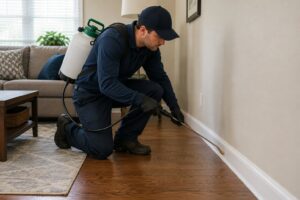
Professional ant control focuses on eliminating the source of the infestation rather than simply reducing visible activity. Technicians identify the ant species involved, locate likely nesting areas, evaluate contributing conditions, and select treatment methods designed to target the entire colony.
Because every infestation is different, professional treatments are tailored to the specific situation. This comprehensive approach often provides longer-lasting results than DIY products alone.
At AVID Pest Services, we understand that successful ant control requires more than killing the ants you can see. Our treatments focus on addressing active colonies, reducing ant pressure around the property, and targeting the factors that contribute to recurring infestations. For carpenter ant infestations, we treat the entire home to help eliminate both primary and satellite colonies that may be hidden throughout the structure. By combining effective treatment methods with expert recommendations, we help homeowners achieve reliable and long-lasting ant control.
If ants keep returning despite sprays, baits, or previous treatments, there is likely an active colony continuing to support the infestation. Professional treatment can identify the source of the problem and provide a solution designed for long-term control.
AVID Pest Services provides professional ant control services for carpenter ants, pavement ants, and other common ant species. Our proven treatment methods are designed to eliminate active infestations and help prevent future problems.
Contact AVID Pest Services today to schedule your ant treatment and stop recurring ant infestations before they become a larger problem.
Looking for the best pest control service in Ontario? At Avid Pest Services, our exterminators are skilled to prevent any kind of pest from your residential and commercial area in a timely and efficient manner. Call today to get a free quote.
2023 Avid Pest Services. All Rights Reserved.